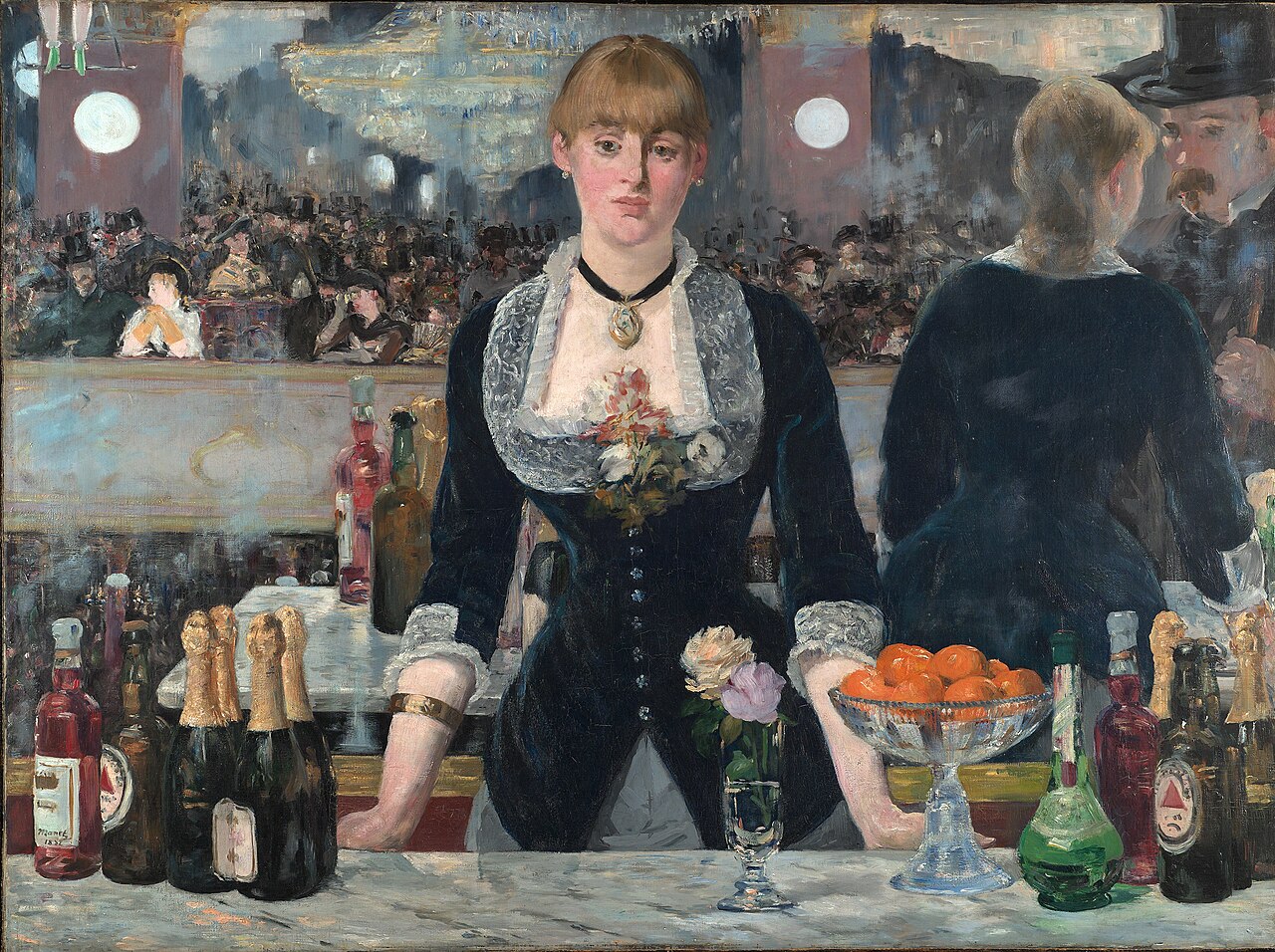
Édouard Manet's 'A Bar at the Folies-Bergère' is a pivotal work that captures the Parisian nightlife and the complexities of modern urban existence. It depicts a barmaid, Suzon, standing before a mirror reflecting the bustling Folies-Bergère music hall behind her. The painting is renowned for its ambiguous spatial arrangement, particularly the distorted reflection in the mirror, which challenges traditional perspective and invites multiple interpretations. Manet masterfully blends still-life elements, portraiture, and genre painting, creating a scene that is both glamorous and melancholic, reflecting on isolation amidst the spectacle of modernity.
About the Artist
Édouard Manet (1832–1883) was a French painter whose work was instrumental in the transition from Realism to Impressionism. He painted modern life subjects—cafés, street scenes, portraits—with a radical new style characterized by bold, flat areas of color, simplified forms, and a directness of gaze that often shocked contemporary audiences. Manet's rejection of academic conventions and his emphasis on the immediate impression of light and color, rather than narrative or traditional finish, paved the way for the Impressionist movement, though he maintained an independent artistic path.
Dominant Color Palette
#303038
Midnight Black
Defines the barmaid's bodice and the deep shadows, providing stark contrast and anchoring the composition.
#F0EFE7
Oyster White
Illuminates the barmaid's blouse and the highlights on bottles, suggesting light sources and capturing surface sheen.
#A78C53
Gilded Gold
Captures the sparkle of bottles, fruit, and the bar's luxurious elements, adding warmth and opulence.
#7A5F45
Mahogany Brown
Forms the polished wooden bar, creating depth and a rich, grounded foreground.
#4D6B5A
Emerald Green
Accents the labels on bottles and hints at the distant, blurred figures in the music hall background, adding vibrancy.
#8C9BA2
Smoky Grey-Blue
Depicts the atmospheric distance and the reflections within the mirror, lending a cool, ethereal quality to the background.
Technique: Direct Painting (Alla Prima) & Ambiguous Perspective
Manet employed direct painting, applying paint wet-on-wet with visible brushstrokes, coupled with an innovative use of a mirror to create a complex and spatially ambiguous composition.
Manet's 'A Bar at the Folies-Bergère' is a masterclass in direct painting, where colors are often applied side-by-side with minimal blending, giving the work an immediate and vibrant quality. His brushwork ranges from broad, confident strokes in the background, dissolving figures into a lively blur, to more precise detailing in the still life elements and the barmaid's face. The genius of the technique lies in the intentionally distorted reflection in the mirror, which defies realistic perspective, creating a sense of psychological distance and inviting the viewer to question reality and perception, a hallmark of Manet's modernity.
Medium & Materials: Oil on Canvas
This work is executed in oil paints on a canvas support, allowing for rich color saturation, varied textures, and robust layering.
Manet used traditional oil paints on a finely woven canvas, prepared with a light ground, likely a gesso. The oil medium afforded him the flexibility to work both 'alla prima' (wet-on-wet) for immediate effects and to build up subtle glazes, particularly in the reflective surfaces and the more delicate textures of the still life. The pigment choices contribute to the painting's vibrancy, with Manet often favoring strong contrasts and a slightly flattened, almost graphic quality in his application. The slow drying time of oil paints allowed for seamless transitions and careful blending in certain areas, while simultaneously permitting bold, unblended passages that define his distinctive brushwork.