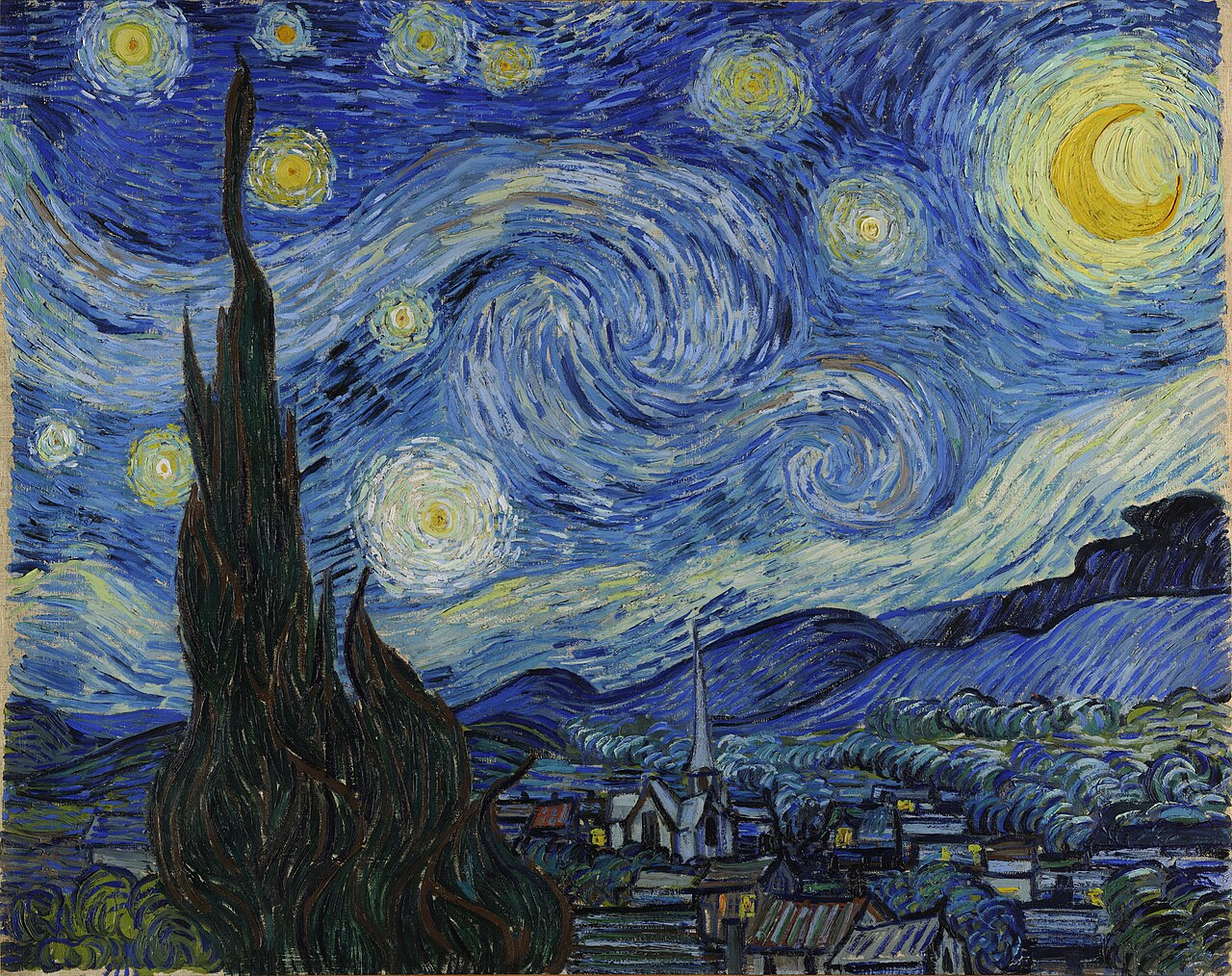
The Starry Night is one of the most recognized masterpieces in the history of Western art. It depicts the view from the east-facing window of Van Gogh's asylum room at Saint-Rémy-de-Provence, just before sunrise, with the addition of an idealized village. The painting is characterized by its dramatic, swirling celestial forms, the towering, flame-like dark cypress tree, and the tranquil village below. It is often interpreted as a visual representation of Van Gogh's tumultuous emotional state, blending observation with deep personal feeling and imagination.
About the Artist
Vincent van Gogh (1853–1890) was a Dutch Post-Impressionist painter whose work, notable for its beauty, emotion, and color, profoundly influenced 20th-century art. His oeuvre includes landscapes, still lifes, portraits, and self-portraits, characterized by bold colors and dramatic, impulsive, and expressive brushwork that contributed to the foundations of modern art. Despite suffering from severe anxiety and bouts of mental illness throughout his life, he was astonishingly prolific, creating more than 2,000 artworks in just over a decade.
Dominant Color Palette
#0F1C36
Deep Midnight Blue
Forms the vast, swirling sky, conveying depth and the mysterious expanse of night.
#3B5B8B
Cerulean Vortex
Used in lighter swirls of the sky, creating movement and a sense of cosmic energy.
#E8B90A
Vibrant Star Yellow
Illuminates the stars and the crescent moon, symbolizing divine light and hope amidst the darkness.
#8F9F3B
Cypress Verdant
The dark, almost black-green of the cypress tree, acting as a vertical anchor and a symbol of longing or aspiration.
#A3B6BB
Pale Village Grey
Used for the village structures, offering a calming, grounded contrast to the dramatic sky above.
#D1C2A7
Moonlight Glimmer
Subtle light on the moon and occasional highlights, adding a soft, ethereal quality.
Technique: Impasto
Impasto is a painting technique where paint is laid on an area of the surface in very thick layers, usually thick enough that the brushstrokes are visible. This adds texture to the painting, meaning that the paint appears to come out of the canvas.
In 'The Starry Night,' Van Gogh employs impasto not just for texture but to convey intense emotion and dynamic movement. The thick, sculptural application of oil paint, particularly in the sky, creates a tactile, three-dimensional surface. His distinct, short, choppy, and swirling brushstrokes, often applied directly from the tube, build up the forms of the stars, moon, and cypress tree, making the painting vibrate with energy and emotional intensity. This technique allows light to interact with the paint's surface, creating a luminous, almost living quality.
Medium & Materials: Oil on Canvas
The artwork is an oil painting on canvas, a traditional medium known for its rich colors, blendability, and durability, allowing for both delicate glazes and thick impasto applications.
Van Gogh primarily used oil paints, which allowed him to achieve the vibrant colors and thick, expressive textures seen in 'The Starry Night.' The slow drying time of oil paint gave him flexibility for blending and layering, though he often applied paint rapidly and directly, sometimes wet-on-wet. The pigments used, likely cadmium yellow, Prussian blue, and emerald green, are known for their intensity. The canvas provided a sturdy, absorbent ground, prepared with gesso, which accepted the heavy application of paint and allowed for the characteristic textural buildup that defines his style.