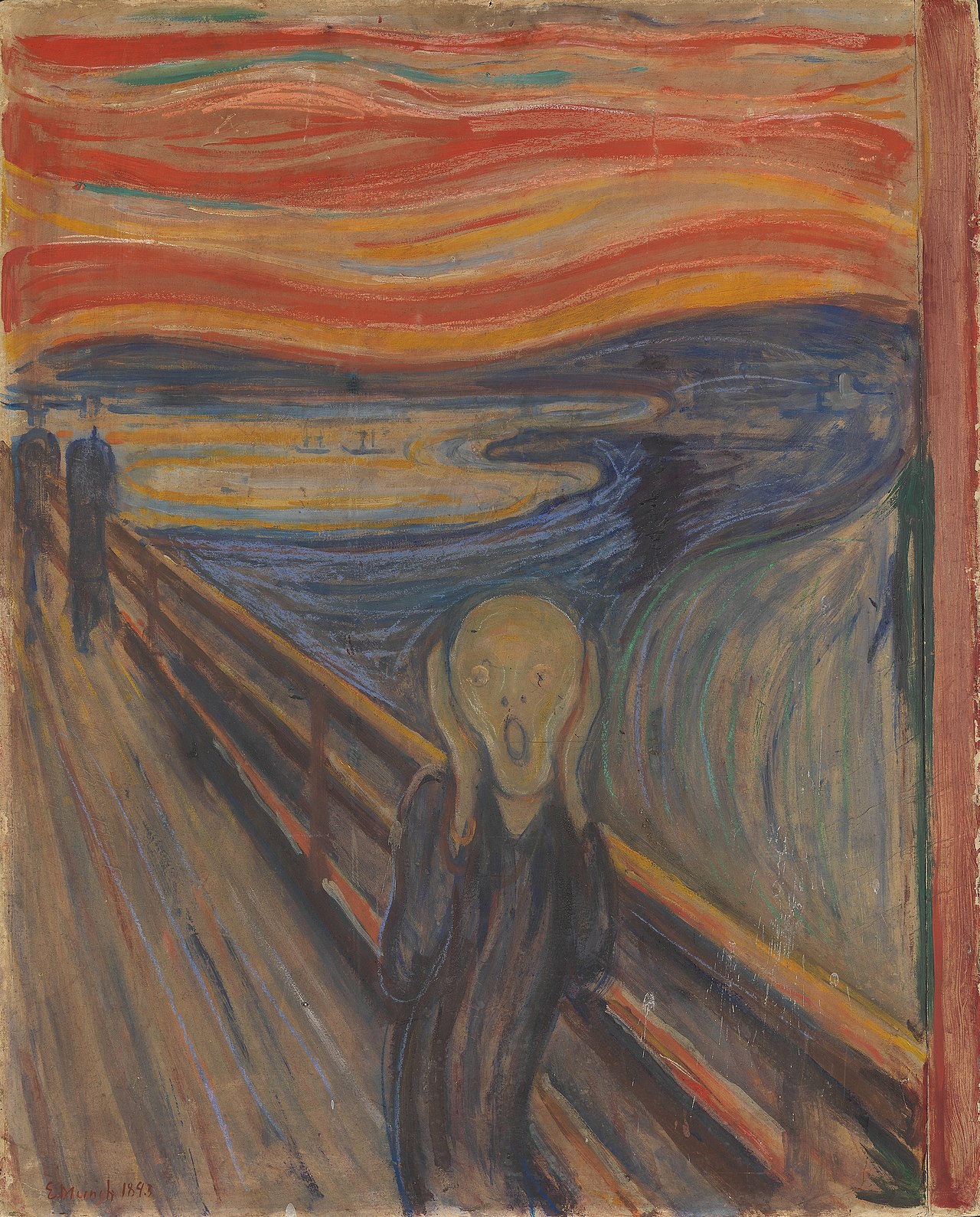
The Scream is Edvard Munch's iconic portrayal of universal anxiety and existential dread. It depicts a genderless figure with an agonal expression against a swirling, blood-red sky, symbolizing humanity's profound unease in the face of nature and modernity. The painting transcends mere depiction to become a visual metaphor for the psychological anguish that Munch himself experienced, and which resonated with the fin-de-siècle mood of Europe, marking it as a seminal work in the development of modern art.
About the Artist
Edvard Munch (1863-1944) was a Norwegian painter whose intensely evocative works explored themes of love, fear, death, and melancholy, deeply rooted in personal trauma and existential reflection. A pioneer of Expressionism, Munch developed a highly personal and symbolic style, characterized by vivid color, distorted forms, and expressive lines, used to convey internal psychological states rather than objective reality. His art profoundly influenced the development of German Expressionism and continues to be revered for its powerful emotional depth and exploration of the human condition.
Dominant Color Palette
#CD3333
Blood Red
Dominant in the sky, symbolizing anguish and alarm.
#FFA500
Fiery Orange
Blends with red in the sky, adding intensity and an unnatural heat.
#00008B
Midnight Blue
Used in the fjord and shadowed figures, representing depth, coldness, and the abyss.
#228B22
Forest Green
Appears in patches in the landscape, providing a stark, contrasting chill.
#F0EAD6
Ghostly White
The pale, skull-like face of the screaming figure, conveying terror and vulnerability.
#4B3621
Burnt Umber
Used for the bridge and figures, grounding the composition with a dark, earthy tone.
Technique: Expressive Brushwork & Distorted Forms
Munch employed bold, swirling brushstrokes and deliberately distorted figures to convey intense emotional states rather than realistic depiction. This technique emphasizes the subjective experience of the artist and the viewer.
The paint is applied with a raw, almost violent energy, visible in the agitated, curvilinear lines that define the sky and water. The forms are simplified and abstracted, particularly the central figure, whose face is reduced to an iconic, skull-like mask. This distortion amplifies the sense of terror and psychological distress, blurring the lines between the internal and external world. Color is used non-representationally, serving to heighten emotional impact and create a sense of vibrating unease.
Medium & Materials: Oil, Tempera, and Pastel on Cardboard
Munch famously utilized a mixed-media approach for "The Scream," combining the rich texture of oil paint, the quick-drying properties and matte finish of tempera, and the vibrant, direct application of pastel on an untreated cardboard surface.
The combination allowed for diverse textural effects and layering. Oil paint provided depth and luminosity, while tempera, an egg-based medium, offered a flatter, more opaque quality and dried quickly, enabling rapid layering. Pastel, a dry medium, was applied with broad strokes, particularly in the sky, to achieve vibrant, hazy effects and to reinforce the raw, immediate emotional impact. The cardboard surface, often left visible in parts, contributes to the painting's starkness and immediacy, soaking up the paint and accentuating the dry, brittle feel in some areas.