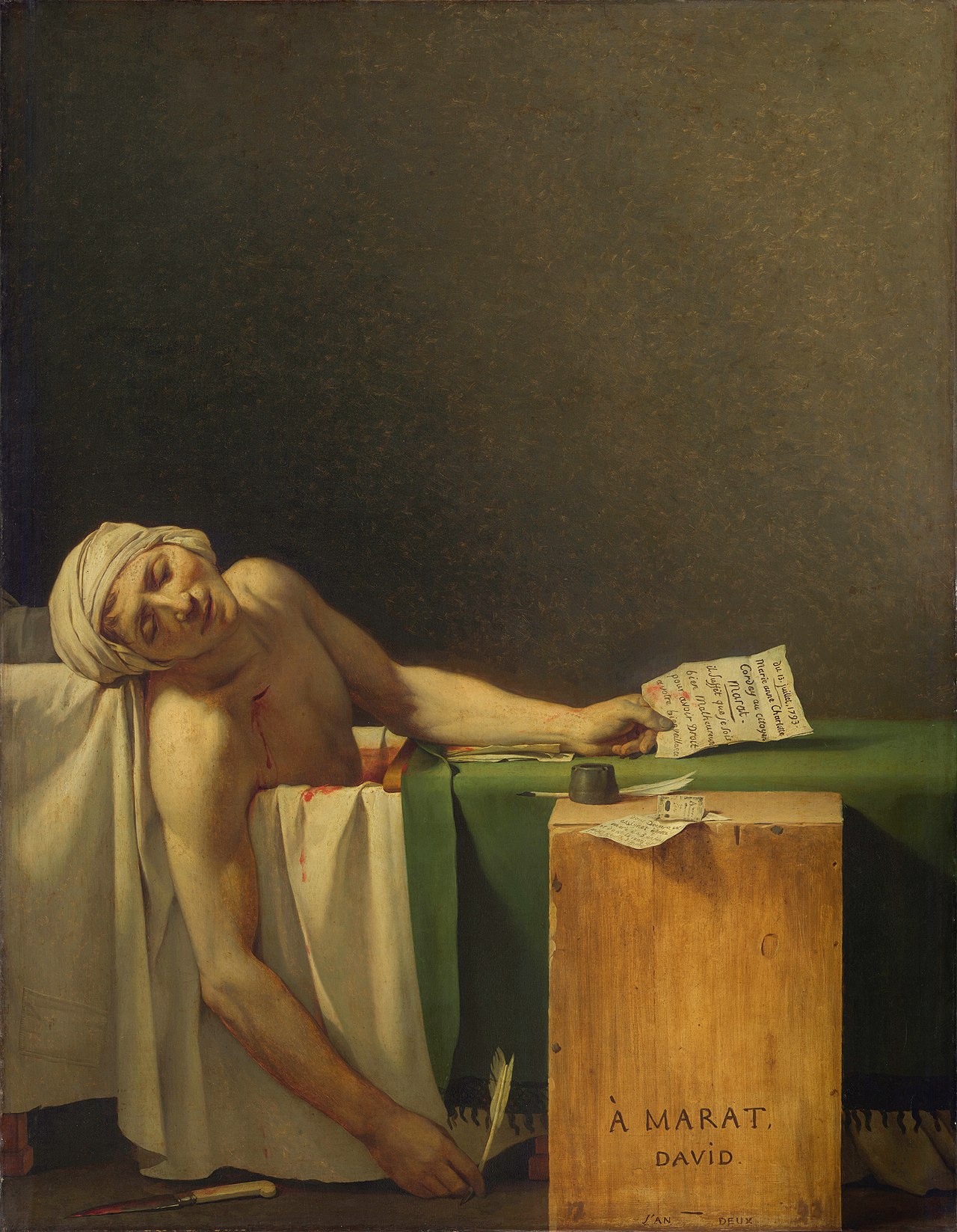
Jacques-Louis David's 'The Death of Marat' is a poignant and powerful portrayal of the assassinated French revolutionary leader Jean-Paul Marat. Depicting Marat lifeless in his medicinal bath after being stabbed by Charlotte Corday, David transforms a gruesome political murder into a scene of idealized martyrdom. The painting's stark simplicity, dramatic lighting, and classical allusions evoke a sense of tragic grandeur, presenting Marat as a heroic, almost saint-like figure who sacrificed himself for the revolutionary cause. It stands as a profound testament to revolutionary fervor and personal sacrifice.
About the Artist
Jacques-Louis David was a pivotal figure in French Neoclassicism and one of the most influential painters of his era. Rejecting the frivolity of Rococo, David embraced a severe, moralizing style inspired by classical antiquity and the Enlightenment. His art played a significant role in shaping public opinion during the French Revolution, for which he served as a propagandist, and later as court painter to Napoleon. His signature style is characterized by precise drawing, sculptural forms, dramatic compositions, and a meticulous finish, embodying the dignity and seriousness of his subjects.
Dominant Color Palette
#26231C
Deep Umber Shadow
The oppressive, nearly black background, symbolizing fate and the stark reality of death.
#F0DBC9
Luminous Flesh Ochre
Marat's pale, almost glowing skin, suggesting purity and the tragic vulnerability of his form.
#E8E8E8
Stark Linen White
The white sheet and turban, acting as a dramatic contrast and a symbol of Marat's simple life.
#B01E25
Crimson Blood
The vivid red of Marat's wound and the bloodied knife, a focal point of the assassination's brutality.
#4A524A
Muted Olive Grey
Subtle, dark greens and greys within the shadows, adding depth and a somber undertone to the composition.
#7F5E3C
Warm Wood Brown
The wooden crate and bath, providing an earthy anchor and a subtle warmth amidst the cool palette.
Technique: Neoclassical Chiaroscuro & Linearity
This technique combines strong contrasts between light and shadow (chiaroscuro) to create dramatic volume, with an emphasis on crisp, sculptural lines (linearity) over painterly effects, characteristic of Neoclassicism.
David employs a masterful chiaroscuro, bathing Marat's body in a Caravaggio-esque light that starkly contrasts with the deep, somber background, thereby isolating and emphasizing the tragic figure. The brushwork is incredibly smooth and refined, aiming for an invisible hand to create an idealized, almost sculptural surface. This meticulous linearity defines forms with crisp contours, giving Marat's body a monumental, classical presence, elevating the scene from a mere news report to a timeless, heroic depiction of sacrifice.
Medium & Materials: Oil on Canvas
The artwork is executed in oil paints on a finely woven canvas, allowing for rich color saturation, smooth transitions, and a durable, luminous finish.
David utilized traditional oil paints, likely incorporating pigments such as Lead White for luminosity, earth tones (ochres, umbers) for the muted background and wood, and vermillion or other vibrant reds for the blood. The canvas was probably finely prepared linen, primed with gesso to create a smooth, non-absorbent surface ideal for David's precise drawing and layered glazing. The oil medium, likely thinned with linseed oil, enabled slow drying, allowing for seamless blending and the creation of the highly polished, almost porcelain-like finish characteristic of Neoclassical painting, devoid of visible brushstrokes.