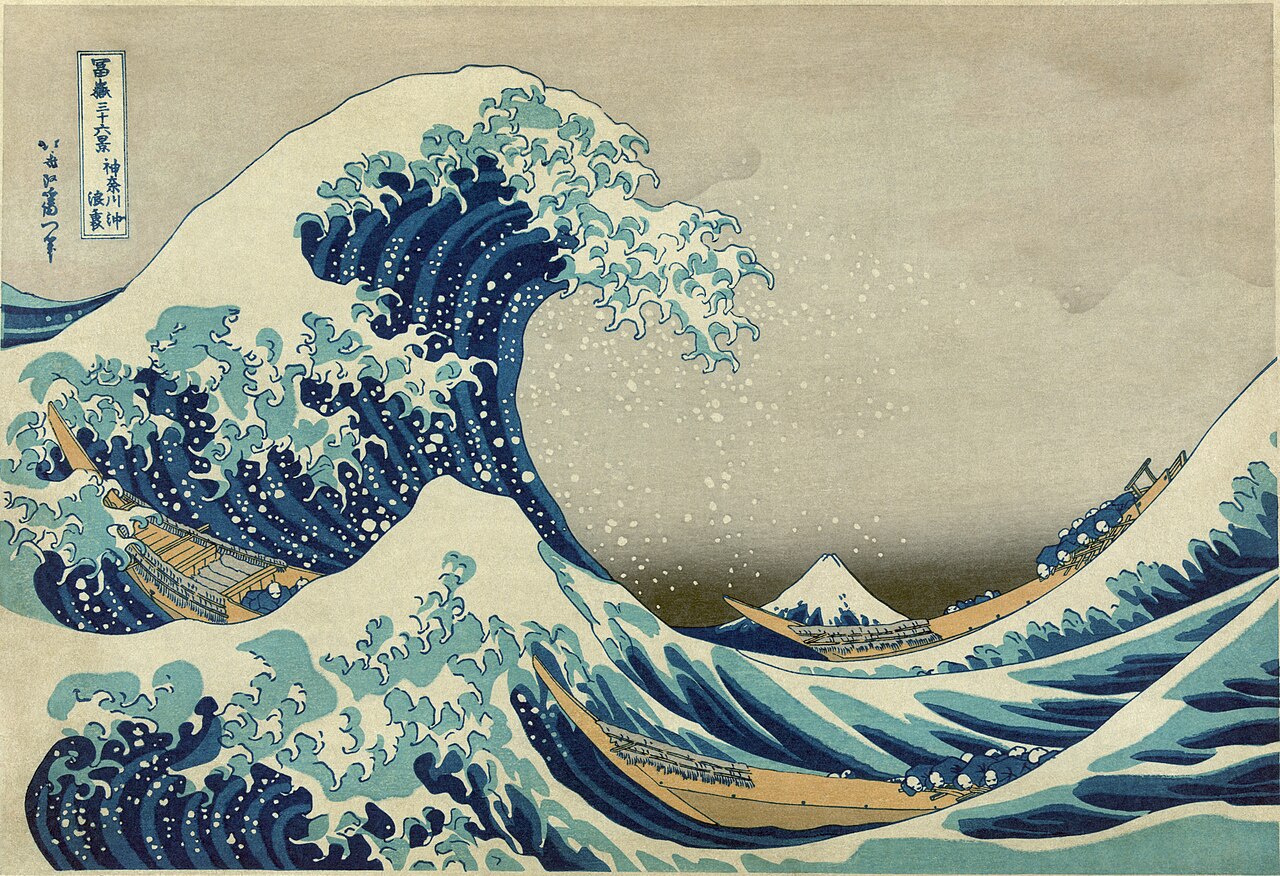
The Great Wave off Kanagawa is an iconic ukiyo-e woodblock print that captures a colossal wave threatening three boats, with Mount Fuji visible in the distance. It is the most famous work in Hokusai's series 'Thirty-six Views of Mount Fuji' and serves as a powerful testament to the overwhelming force of nature contrasted with the enduring presence of Japan's sacred mountain. The composition is dynamic, employing Western perspective techniques while retaining traditional Japanese aesthetic sensibilities, and its striking imagery has made it one of the most recognized artworks in the world, influencing countless artists and designers.
About the Artist
Katsushika Hokusai (1760–1849) was a prominent Japanese ukiyo-e artist of the Edo period, renowned for his woodblock prints, paintings, and book illustrations. Throughout his prolific career, which spanned over seven decades, Hokusai used more than thirty names and explored a vast range of subjects, from courtesans and kabuki actors to flora, fauna, and landscapes. He is celebrated for his innovative compositions, mastery of line, and the introduction of new perspectives into Japanese art, leaving an indelible mark on both Eastern and Western art history, particularly through his 'Thirty-six Views of Mount Fuji' series and the influential 'Hokusai Manga'.
Dominant Color Palette
#00305F
Deep Indigo Blue
Dominant color of the wave, conveying depth and immense power.
#FFFFFF
Pure White
Representing the frothy crests of the waves and the snow on Mount Fuji.
#70B8DF
Sky Blue
Lighter shades in the sky and the receding water, providing atmospheric contrast.
#D1B88F
Pale Ochre
Used for the boats and the distant horizon, adding warmth and realism.
#2F2F2F
Dark Grey/Black
Defining outlines, details on the boats, and the dark underbelly of the wave.
#F5F5DC
Paper Beige
The natural tone of the Japanese paper, showing through in lighter areas.
Technique: Ukiyo-e Woodblock Printing (Nishiki-e)
Ukiyo-e woodblock printing is a multi-step artisanal process involving a designer, carver, and printer, who collaborate to create prints by carving separate woodblocks for key lines and each distinct color, then hand-printing them onto paper.
The technique of ukiyo-e woodblock printing begins with the artist's initial drawing. This design is then transferred to a 'key-block' (usually cherry wood), which is carved to define all the black outlines. Subsequently, separate 'color blocks' are carved for each distinct color area. The printer then meticulously applies water-based pigments, often mixed with rice paste (nori) for specific effects like gradation (bokashi), to each block using brushes. Finally, the paper is carefully laid onto the inked blocks and pressed with a 'baren' (a hand-held printing pad) to transfer the color, ensuring precise registration using 'kento' (registration marks) to align the multiple blocks accurately for the final polychrome image.
Medium & Materials: Woodblock Print on Japanese Paper (Nishiki-e)
This artwork is a polychrome woodblock print (nishiki-e), created using water-based inks on high-quality Japanese paper, primarily utilizing vegetable-based pigments and the newly introduced synthetic Prussian blue.
The print was produced on 'washi' paper, a type of traditional Japanese paper known for its strength, durability, and absorbency, often made from kozo (mulberry) fibers. The pigments were largely water-based, mixed with a paste made from rice (nori) to control their viscosity and allow for subtle effects like transparent washes and color gradients. The groundbreaking use of imported Prussian blue pigment (bero-ai) provided a rich, vibrant, and light-fast blue that was superior to traditional indigo, becoming a signature element in Hokusai's landscapes. The interplay of these pigments with the paper's texture and the layered printing process gives the print its characteristic visual depth and subtlety.